


Richard Long
The Processual Nature of Land Art in the Work of Richard Long: The ‘RHEIN MUD LABYRINTH’ at the Museum Kurhaus Kleve
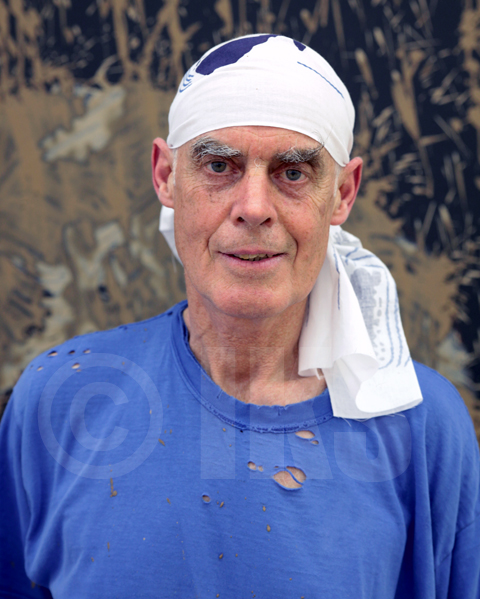
The British conceptual and Land Art artist Sir Richard Long (born in Bristol in 1945) is one of the most influential figures in international art history of the late 20th and early 21st centuries. Since the late 1960s, he has fundamentally expanded the concept of sculpture by establishing walking, the passage of time and physical movement in nature as primary artistic media. Long’s minimalist interventions draw on universal basic geometric forms such as lines, circles and spirals, which he shapes from found natural materials such as stones, driftwood and mud. His work, which has gained international recognition, is represented in all major public and private collections worldwide.
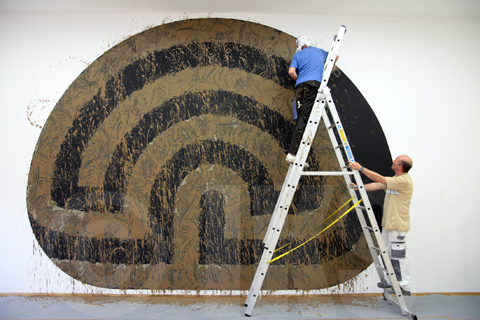
A key point of reference in continental Europe is the Museum Kurhaus Kleve, with which the artist has a long-standing institutional collaboration. To mark the 2013 exhibition ‘Richard Long. Prints 1970–2013’, which brought together his body of print work comprehensively for the first time, the artist created a site-specific, monumental wall installation inside the museum. This work, titled ‘RHEIN MUD LABYRINTH’, exemplifies the conceptual transfer of landscape processes and materials into the museum space.
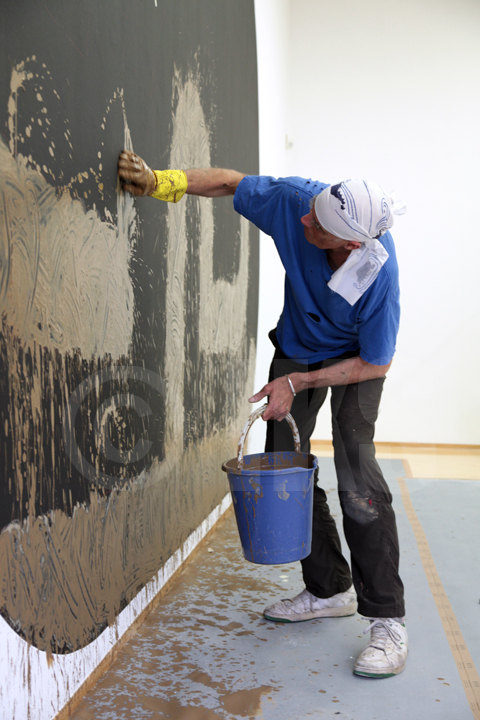
The process of creating the wall piece is based on a physically intensive, time-compressed intervention. To achieve this, Long applied an emulsion of local Rhine mud and water directly with his hands to a prepared, dark wall surface. The resulting texture contrasts the architectural austerity of the institution with the amorphous, sedimentary dynamism of the natural material. As a result of the subsequent drying process, the surface breaks up into a relief-like pattern, permanently inscribing the course of the river, the behaviour of the material and the immediate gesture of the act of painting. The work was permanently transferred to the museum’s Ewald Mataré Collection as a donation from the artist.
The genesis of this creative process at the Museum Kurhaus Kleve was exclusively documented on film by the IKS and Ralph Goertz. The resulting visual material makes a significant contribution to art-historical research and the communication of Land Art. It deconstructs Richard Long’s process-oriented working method by documenting the physical dynamics, the technical precision and the immediate relationship between the artist, the material and the spatial arrangement at the very moment of creation, thereby preserving them for future discourse.
photos: Ralph Goertz © IKS-Medienarchiv